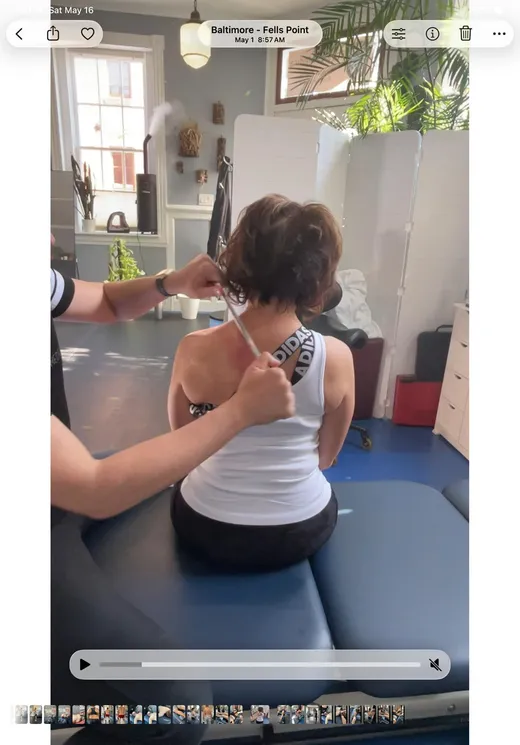
One-on-One Manual Therapy
Direct hands-on fascial release and joint mobilization targeting the shoulder, scapula, thoracic spine, and cervical attachments. The full hour is with Dr. Birikov. No aides, no handoffs.
Learn more →
Hands-on manual therapy for shoulder pain that has already survived PT, cortisone, and months of waiting it out. If the pain keeps coming back, the source has not been found yet.
Dr. Maks Birikov, DPT is a licensed physical therapist and the first practitioner in Baltimore certified at the master level in dry needling.
Request a ConsultationFull-hour, one-on-one sessions at 800 S Bond St in Fells Point.
You may already have a name for it. Rotator cuff tendinopathy. Impingement. Bursitis. A labral tear that was deemed too small to operate on. The diagnosis explains what is irritated. It rarely explains why it got that way or why it returns every few months.
The shoulder is the most mobile joint in the body, which means it depends almost entirely on the surrounding soft tissue for stability. When the thoracic spine is stiff, the neck is compressed, or the fascia along the chest and upper arm is restricted, the shoulder compensates on every single movement. That compensation is what wears tissue down over time. Treating the shoulder alone is treating the symptom.
Most patients who arrive here have done rotator cuff exercises. They helped for a while, or they didn't help at all. That is because loading a restricted system rarely resolves the restriction. The tissue has to be released first.
The assessment does not start and end at the shoulder. It traces the chain: cervical spine, thoracic mobility, rib cage mechanics, scapular movement, pec minor and bicipital fascia, the rotator cuff itself. The goal is to find where movement has stopped and why the shoulder has been compensating.
Once the restriction pattern is clear, the manual work begins. Release where the tissue is locked. Mobilization where the joint is not moving. Dry needling where the muscle has a trigger point that will not let go manually. The session is built around what the tissue is actually doing that day, not a fixed protocol.
After the restriction is cleared, the loading pattern is addressed. Not an exercise circuit. A specific correction in how the shoulder moves under load so the problem does not rebuild itself.
Most sessions draw on two or three of these depending on what the tissue needs. Nothing is applied by default.
Direct hands-on fascial release and joint mobilization targeting the shoulder, scapula, thoracic spine, and cervical attachments. The full hour is with Dr. Birikov. No aides, no handoffs.
Learn more →Instrument-assisted soft tissue mobilization uses steel tools to detect and break down adhesion in the fascia and tendons around the shoulder. The instruments transmit texture the hands alone cannot feel, which makes them particularly effective on the rotator cuff tendons and the bicipital groove where scar tissue accumulates.
Learn more →A fine filament needle is inserted directly into a trigger point in the rotator cuff, subscapularis, or surrounding musculature. The needle produces a local twitch response that releases the contraction and restores blood flow to tissue that has been chronically compressed. Dry needling is not acupuncture. It targets specific muscular dysfunction identified on assessment. Dr. Birikov holds a master-level certification and performs dry needling within Maryland physical therapy licensure.
Learn more →Suction cups create negative pressure that lifts the fascia away from the layers beneath it. This restores glide between tissue planes that have stuck together, particularly useful along the posterior shoulder, upper trapezius, and pec minor. Cupping can leave temporary circular marks on the skin. They are not bruises and typically fade within a few days.
Learn more →Shoulder pain that radiates into the arm, causes numbness, or feels electrical often involves a nerve that is being compressed or tethered somewhere along its path. Neural tension techniques free the nerve at the site of restriction rather than only treating the shoulder itself.
Learn more →Once the restriction is cleared, the movement pattern that created it has to change. This means correcting how the scapula tracks and how the thoracic spine contributes to overhead and reaching movements, so the shoulder is not absorbing load it was never designed to carry alone.
Learn more →The first session is a full hour. The first fifteen to twenty minutes are assessment: range of motion, tissue quality, movement patterns, and a review of what has already been tried. Treatment begins in the same session.
Deep tissue work can be intense while it is happening. It is common to feel sore for a day or two afterward, particularly after dry needling or IASTM on a long-restricted area. That soreness is normal and typically passes quickly. Most patients feel noticeably different within the first two or three sessions.
Most shoulder pain patients see meaningful change within four to six sessions. Longer-standing patterns or post-surgical tissue may require more. An honest estimate is given after the first session assessment, not before.
Exercise-based PT loads a restricted system. That is why it helps temporarily and then the pain returns. The restriction has to be addressed in the tissue before loading makes sense. That is the sequence this practice follows.
Prior treatment failure is not a reason to give up. For most patients who come here, it is the reason they are finally in the right place. The shoulder was treated. The chain that was driving the problem was not.
No referral is required. You do not need to be an existing patient. Send a message describing the pain, how long it has been there, and what has already been tried. Dr. Birikov reads every inquiry personally and responds directly.
Describe your shoulder pain, how long it has been there, and what treatments have already failed. The more specific you are, the more useful the response will be.
Dr. Birikov reviews every message personally and responds directly. No intake forms routed through a front desk. Reach out by phone at 443-228-8029 or send a message through the contact page.