
Posture Correction in Baltimore
Dr. Maks Birikov, DPT · Functional Patterns practitioner · Pancafit-certified postural specialist · 800 S Bond St, Baltimore, MD 21231
If you have tried ergonomic chairs, posture braces, stretching routines, or a round of physical therapy and your posture keeps reverting, the problem is not your effort. It is that none of those approaches addressed what is actually holding your body in that position.
Out-of-network by design. HSA and FSA accepted.
Why Posture Correction Fails and What Actually Works
Most posture correction programs treat posture as a habit. Stand taller. Pull your shoulders back. Strengthen your core. The advice is not wrong, exactly, but it is incomplete in a way that explains why so many people follow it faithfully and still end up in the same position six months later.
What those programs miss is fascia — the dense connective tissue that wraps every muscle, bone, and organ in your body. Fascia holds shape. When it tightens around a dysfunctional position over months or years, it physically locks the body there. No amount of conscious effort overrides a fascial restriction. Your muscles fire, you straighten up, and the moment you stop thinking about it, the tissue pulls you back.
There is also the question of movement patterns. Posture is not a static position. It is the average of every movement you make. If the way you move through the day is organized around the dysfunction, correcting the resting position without correcting the pattern means the pattern rebuilds the dysfunction every day.
What Posture Re-Education Involves at Physica Medica
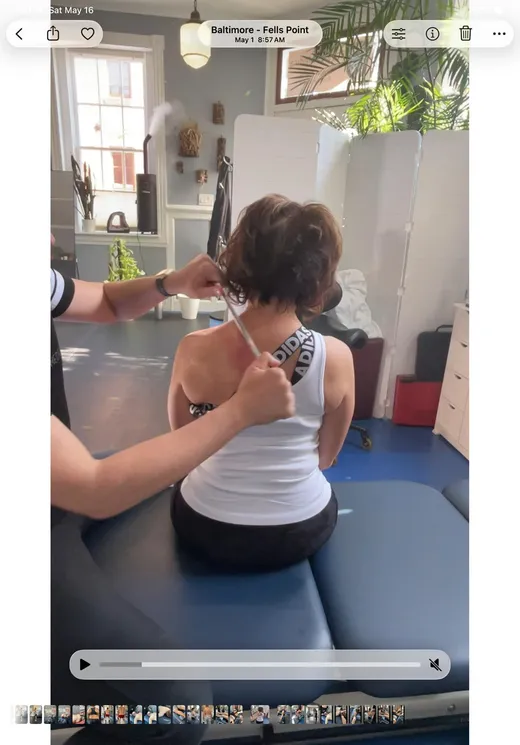
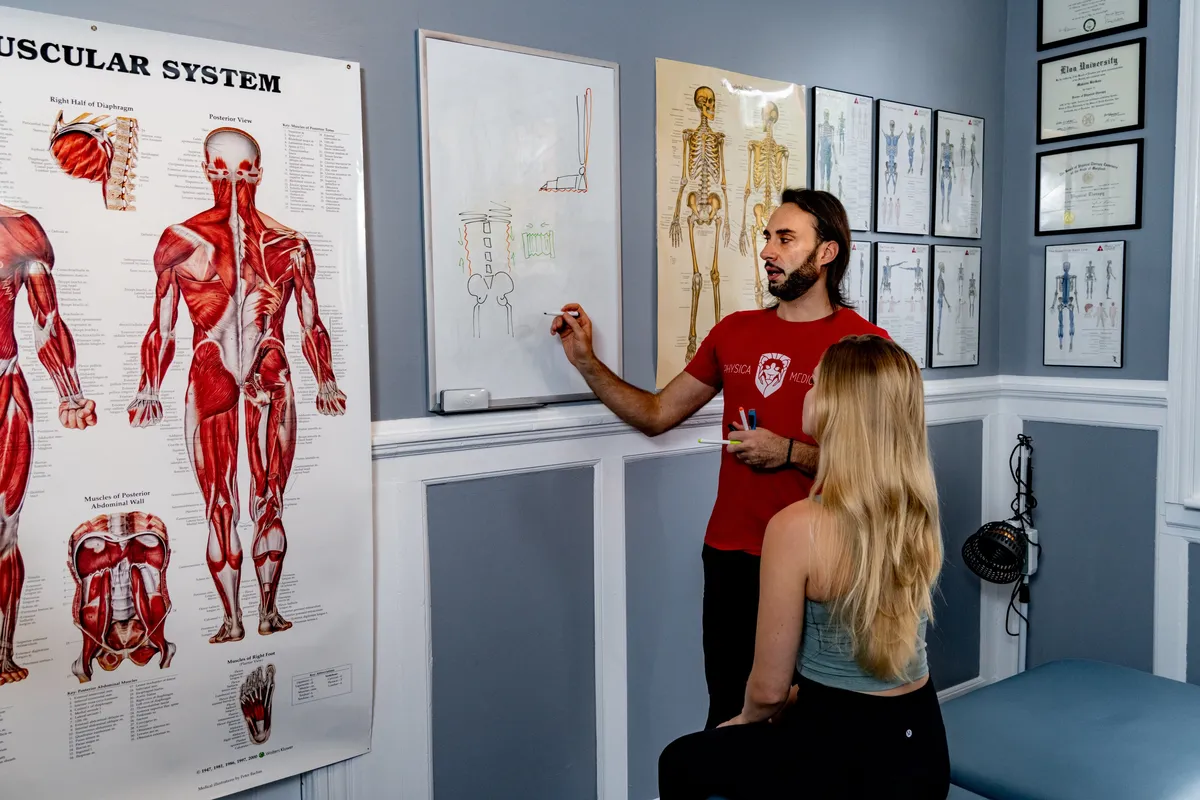
This is not a posture program. There is no handout, no set of exercises to take home, no app to remind you to sit up straight. What happens here is hands-on assessment and manual treatment, with movement re-education built around what the assessment actually finds.
This is for you if
- You want hands-on bodywork: fascia, joint, nerve, needle. Not a program of exercises.
- You have already tried PT, massage or chiropractic and are still in pain.
- Your problem is chronic, recurring, or has never been explained to your satisfaction.
- You would rather have one hour with the doctor than three appointments with three people.
- You are willing to pay out of pocket for undivided expert attention.
This is not for you if
- You are looking for an exercise-based rehab program supervised by an aide.
- You need a clinic that bills your insurance directly and books you three times a week.
- You have an acute traumatic injury that needs imaging or surgical evaluation first.
- You want a single visit that makes a decade-old pattern disappear.
Conditions That Respond to Postural Correction
Postural dysfunction is rarely the complaint. It is usually the cause behind the complaint. Patients come in for neck pain, headaches, jaw tension, mid-back stiffness, or breathing problems and discover that a structural postural pattern is generating all of it.
A shoulder that lives in the rib cage
Conditions that commonly involve a postural component include forward head posture, thoracic kyphosis (rounded upper back), scoliosis, chronic neck and upper back pain, tension headaches, TMJ dysfunction, rib restriction, and breathing dysfunction. Sciatica and lower back pain often have a postural driver that goes unaddressed when treatment focuses only on the lumbar spine.
A hip held by a fifteen-year-old scar
If you have been told your pain is from 'bad posture' but no one has done anything about the posture itself, only the pain, this is the gap that postural re-education addresses.
The Role of Fascia, Muscle Memory, and Movement Patterns
Three things hold the body in a dysfunctional position. Most conventional treatment addresses one of them, at best.
How Pancafit and Functional Patterns Support Postural Change
History, briefly
Dr. Birikov is the first and only Functional Patterns practitioner in Baltimore. Functional Patterns is a method of movement re-education built around the four foundational human movements: standing, walking, running, and throwing. It addresses postural dysfunction at the movement pattern level rather than the muscle-by-muscle level.
Assessment by hand
Pancafit is a postural stretching apparatus developed in Italy that uses gravity and body weight to create sustained, whole-chain fascial release. Unlike static stretching, which targets individual muscles, Pancafit works along the full fascial lines that connect from foot to skull. Those are the same lines that, when shortened, produce the forward head, rounded shoulder, and compressed thoracic patterns most patients are trying to correct.
Treatment, same visit
These two approaches are not interchangeable with generic posture exercises. They work at the level where the problem actually lives: fascial restriction and movement pattern dysfunction. Physica Medica is the only practice in Baltimore that brings both into a single treatment framework.
An honest arc
Before you leave, an estimate of how many sessions this will take and what will change first. Most patients feel meaningful change within four to six.
Deep manual work can be intense while it is happening and can leave a day or two of soreness, the kind that follows hard exercise rather than injury. Cupping can leave circular marks that fade within a week. Dr. Birikov talks through pressure as he works and adjusts on request. Nobody is asked to endure anything silently.
Start Your Postural Assessment in Baltimore
How is one-on-one physical therapy different from PT at a regular clinic?
Can posture actually be permanently corrected, or does it always come back? It depends on whether the treatment addressed the fascial restrictions and movement patterns driving the dysfunction, or only the surface position. Posture that is corrected at the tissue and pattern level does not require constant vigilance to maintain. Posture that is 'corrected' by reminders and exercises alone tends to revert because nothing structural changed.
How many sessions will I need?
How is posture re-education different from just doing posture exercises? Posture exercises work at the muscle activation level. Posture re-education works at the fascial, neuromuscular, and movement pattern level: the layers underneath muscle activation that determine what the muscles do automatically. Exercises can build capacity; they cannot release a fascial restriction or reprogram a deeply learned movement pattern without hands-on intervention.
Do you take insurance for one-on-one physical therapy?
How long does it take to see real postural change? Most patients notice meaningful change in how their body feels within 4 to 6 sessions. Visible, lasting structural change in a chronic pattern typically takes longer. The timeline depends on how long the pattern has been present, how much fascial restriction is involved, and how the body responds to treatment. Dr. Birikov will give you an honest estimate after the first assessment, not a vague range designed to avoid the question.
Book Your Postural Assessment in Baltimore
Send a message describing what you are dealing with, how long it has been present, what you have already tried, and what has not been explained to your satisfaction. No referral is required. New patients are welcome.
Dr. Birikov reads every inquiry personally and responds directly. Physica Medica is located at 800 S Bond St, Baltimore, MD 21231. You can also reach the clinic by phone at 443-228-8029.