Postural Problems & Forward Head Posture Treatment in Baltimore | Physica Medica | Physica Medica
Skip to content
Physica Medica logo
Physica Medica logo Consult
Physica Medica logo
Request a Consultation
Back Pain · Baltimore

Your posture didn't collapse overnight. It won't correct itself with a stretching routine.

Forward head posture, thoracic kyphosis, and hunched upper back are structural problems with downstream consequences — neck pain, headaches, jaw tension, breathing restriction, even vocal strain. Most posture treatment addresses the surface. Dr. Birikov works the underlying fascial and structural patterns that keep pulling you back into the same position.

Dr. Maks Birikov, DPT — the only Functional Patterns practitioner in Baltimore and the only provider in the US offering Pancafit postural stretching.

Request a Consultation

Full-hour, one-on-one sessions in Fells Point at 800 S Bond St, Baltimore, MD 21231.

Why It Returns

What Forward Head Posture and Poor Posture Are Actually Doing to Your Body

Most people think of bad posture as a cosmetic issue. A rounded back. Shoulders that roll forward. Something to fix by sitting up straighter. That framing misses almost everything that matters. Forward head posture shifts the mechanical load on your cervical spine, compresses the suboccipital muscles at the base of your skull, and creates a sustained tension pattern that feeds directly into chronic neck pain, tension headaches, and jaw dysfunction. The head weighs roughly ten to twelve pounds. Every inch it drifts forward multiplies the effective load on the structures holding it up.

Thoracic kyphosis — the exaggerated forward curve of the upper back — doesn't stay in the upper back. It restricts rib cage expansion, which limits how fully the diaphragm can descend. That matters for breathing. It matters more for singers and performers, where diaphragmatic function is the foundation of vocal support. A hunched thoracic spine also pulls the shoulder blades into a position that loads the rotator cuff unevenly, which is why many shoulder problems trace back to thoracic restriction rather than anything wrong with the shoulder itself.

The pattern runs further. Tight thoracolumbar fascia from years of forward loading alters how the pelvis sits, which changes how the lumbar spine loads, which is often the actual origin of low back pain that has been treated repeatedly at the lumbar level without lasting results. Posture is a whole-system problem. Treating one segment of it is why most posture treatment doesn't hold.

The Approach

Why Posture Problems Don't Fix Themselves With Exercise Alone

Standard posture correction advice — strengthen your core, do rows, stretch your chest — is not wrong. It's incomplete. Exercise loads tissue. But if the fascia surrounding that tissue is restricted and the structural pattern is already locked in, loading it more doesn't change the pattern. It reinforces it. This is the fundamental reason people do months of posture exercises and still look and feel the same.

Fascia is the connective tissue that wraps every muscle, bone, and organ in the body. When it becomes restricted — through years of sustained posture, repetitive movement, or past injury — it creates a physical pull that no amount of voluntary muscle effort can override. The restriction has to be addressed manually before the tissue can be retrained to hold a different position. Exercises come after release, not instead of it.

This is the distinction between posture re-education and posture exercises. Re-education means releasing the fascial restrictions that are driving the pattern, then reprogramming the movement habits that maintain the correction. It requires hands-on work. It cannot be delivered through a sheet of exercises.

The Toolkit

How Dr. Birikov Corrects Postural Dysfunction

The assessment starts with the whole structure — not just where it hurts or where it looks wrong. Dr. Birikov evaluates fascial tension from the base of the skull through the thoracic spine, rib cage, diaphragm, and into the hips and pelvis. He is identifying where the tissue is restricted, where the joints are compressed, and what the body is compensating around.

One-on-One Manual Therapy

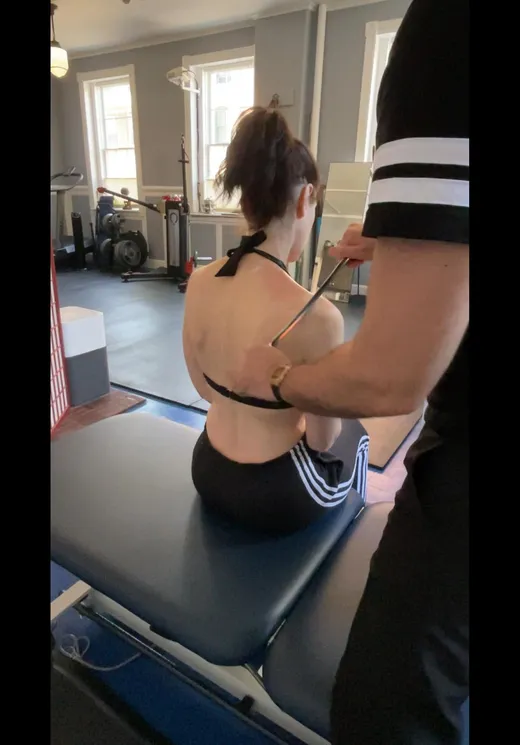
From there, manual work addresses the restrictions directly. Fascial release, joint mobilization, instrument-assisted soft tissue work, and dry needling are used in combination depending on what the tissue is doing that session. Once the restriction is cleared, the structural pattern is retrained through Functional Patterns movement work and, where appropriate, Pancafit postural stretching — a method that places the entire body in specific positions to create a global stretch through the fascial chain rather than targeting one muscle at a time.

Learn more →

IASTM

Pancafit is a specialized stretching apparatus developed in Italy. Dr. Birikov runs the only Pancafit class in the United States. It is not yoga, not foam rolling, and not passive stretching. It is a structured method for creating length through the whole posterior or anterior chain simultaneously, which is what postural correction actually requires.

Learn more →

Dry Needling

A fine filament needle reaches a trigger point in deep spinal musculature and lets it release. Dr. Birikov is Baltimore’s first master dry needler, and the technique is within the licensed scope of physical therapy practice in Maryland.

Learn more →

Myofascial Cupping

Negative pressure lifts the fascia away from the layers beneath it, restoring glide and blood flow. The circular marks are normal and fade within a week.

Learn more →

Neural Tension Release

For back pain with radiating symptoms, the nerve is freed where it is actually bound, not where the numbness is felt.

Learn more →

Posture Re-Education

Once the restriction is gone, the loading pattern is retrained so the correction survives your working week.

Learn more →
Documented

Treatments and Programs for Postural Problems at Physica Medica

Each session draws from the following based on what the tissue needs. Most sessions combine two or three approaches within the same hour.

Manual Fascial Release and Joint Mobilization

Before
After

Hands-on work along the cervical spine, thoracic spine, rib cage, and surrounding musculature. The goal is to restore mobility in the joints and length in the fascia before any structural retraining begins.

Honest Qualification

Thoracic Kyphosis, Hunched Back, and Related Conditions

This is for you if

  • Your back pain is chronic or keeps returning after treatment that helped briefly.
  • You have already done conventional PT, chiropractic or massage without lasting change.
  • You want hands-on manual therapy rather than a supervised exercise circuit.
  • You are prepared to pay out of pocket for full-hour sessions with the doctor.

This is not for you if

  • You have an acute traumatic injury that needs imaging or surgical evaluation first.
  • You have red-flag symptoms such as progressive weakness or bowel and bladder changes, which need medical assessment now.
  • You are looking for insurance-billed visits three times a week.
  • You want one session to undo a decade-old pattern.
The Hour Itself

Start Your Postural Correction in Baltimore

No referral is required. New patients contact Dr. Birikov directly by phone at 443-228-8029 or through the contact form. Describe what you're dealing with, how long it has been present, and what you've already tried. Dr. Birikov reads every inquiry personally and responds directly — not through a front desk or patient coordinator.

The first session includes a full structural assessment before any treatment begins. Most postural correction patients see meaningful change within four to six sessions. Long-standing patterns — a decade or more of thoracic kyphosis, for example — require more time and a consistent commitment to the process. Where a range can't be estimated without assessment, that will be stated plainly at intake.

Most back pain patients feel meaningful change within four to six sessions. Patterns twenty years in the making take longer, and Dr. Birikov will say so directly after the first visit rather than sell you a package before it.

Good Questions

Why Posture Problems Don't Fix Themselves With Exercise Alone

How is hands-on physical therapy different from exercise-based PT for back pain?

How many sessions will I need for back pain treatment?

Can you treat back pain that hasn’t responded to other therapies?

The Next Step

Frequently Asked Questions

Can forward head posture be permanently corrected? In most cases, yes — but the answer depends on how long the pattern has been present and how thoroughly the underlying fascial restrictions are addressed. Forward head posture is maintained by shortened fascia and habituated movement patterns, not by bone structure. When the tissue is released and the movement pattern is retrained, the correction can hold. What it cannot do is hold on its own after a few exercises. The structural work has to come first.

What is the difference between posture re-education and standard posture exercises? Standard posture exercises — rows, chin tucks, chest stretches — work on muscle strength and flexibility in isolation. Posture re-education starts by releasing the fascial restrictions that are physically pulling the body into its habitual pattern, then reprograms the movement habits that maintain the new position. One addresses the symptom. The other addresses what's driving it.

Preview Give Feedback