Neck Pain & Cervicogenic Headache Treatment in Baltimore | Physica Medica | Physica Medica
Skip to content
Physica Medica logo
Physica Medica logo Consult
Physica Medica logo
Request a Consultation
Back Pain · Baltimore

Treated. Again. Still there.

Most neck pain patients have already been through the cycle: adjustments, massage, a round of PT, maybe a steroid injection. The pain comes back. Sometimes it brings headaches with it. If that is where you are, the problem is not that treatment failed — it is that the source was never identified.

Dr. Maks Birikov, DPT, is the first and only practitioner in Baltimore certified in both Functional Patterns and master-level dry needling. He sees one patient at a time, for a full hour, and does not bill insurance.

Request a Consultation

Full-hour, one-on-one sessions at 800 S Bond St in Fells Point.

Why It Returns

The Hidden Connection Between Neck Pain and Headaches

A significant portion of chronic headaches are not migraines and are not originating in the brain. They start in the neck. The term is cervicogenic headache — pain that begins in the cervical spine or the soft tissue around it and refers upward into the skull, the temples, or behind the eyes. Many patients spend years treating the headache without anyone examining the neck as the source.

The upper cervical joints and the suboccipital muscles at the base of the skull share nerve pathways with the trigeminal system, which is why dysfunction there produces head pain that feels identical to a tension headache or a dull migraine. The giveaway is often that the headache starts or worsens with sustained postures — looking at a screen, driving, reading — and that pressing on the base of the skull or the upper trapezius reproduces it.

If your headaches have not responded to migraine medication or standard headache treatment, this is worth knowing. The neck is where the work needs to happen.

The Approach

Why Neck Pain Is Rarely Just a Neck Problem

The cervical spine sits at the top of a chain that runs through the thoracic spine, the ribcage, and the upper back. When the thoracic spine stiffens — as it does in virtually everyone who sits for a living — the neck compensates. It takes on range of motion the thoracic spine is no longer providing. That overload is what creates the chronic tension, the trigger points, and eventually the referred pain into the head.

Forward head posture is the most common structural driver. For every inch the head sits in front of the body's center of mass, the effective load on the cervical spine roughly doubles. The muscles at the back of the neck are working constantly just to hold the head up. They never fully rest. That is not a muscle problem — it is a postural load problem, and it does not resolve with neck stretches alone.

Most practitioners treat the cervical spine in isolation. The thoracic kyphosis driving the whole pattern goes unaddressed, and the neck pain returns within weeks of any treatment that did help. That is the cycle most patients in this practice have already been through.

The Toolkit

How Dr. Birikov Treats Neck Pain and Cervicogenic Headaches

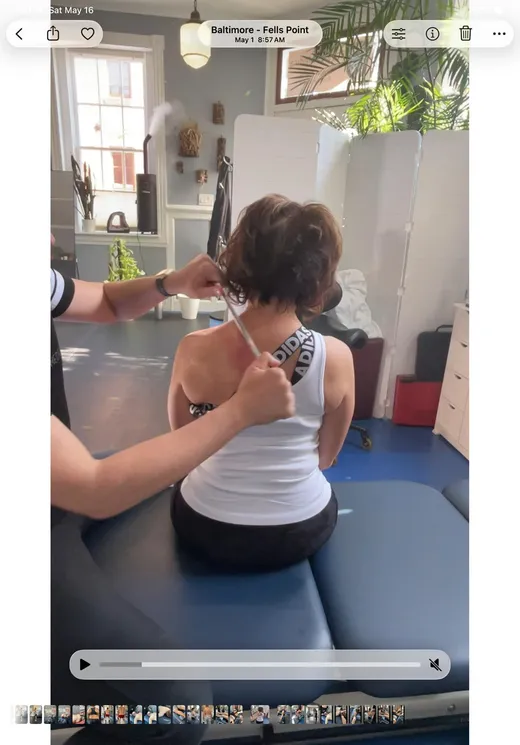
The assessment starts with posture — the whole picture, not just the segment that hurts. Forward head position, thoracic curve, shoulder girdle mechanics. Then a hands-on examination of the cervical and thoracic joints, the suboccipital tissue, the scalenes, and the fascial lines running into the upper back and chest.

One-on-One Manual Therapy

I have been seeing Max for 6 weeks. I tore a muscle, resulting in difficulty walking. Using the routines Max provided, along with my weekly visits, I am no longer in pain. Max's technique and level of professionalism put me at ease as I was evaluating different ways to resolve this problem.

Learn more →
Documented

Treatments Used for Neck Pain at Physica Medica

Most sessions draw on two or three of these depending on what the tissue requires. Nothing is applied by rote.

One-on-One Manual Therapy

Before
After

Direct hands-on work to the cervical and thoracic joints, the suboccipital muscles, the scalenes, and the fascial tissue connecting the neck to the upper back and chest. Joint mobilization restores motion at the segments that have stiffened; soft tissue work addresses the compensation patterns that built up around them.

Honest Qualification

What Patients With Chronic Neck Pain Experience Here

This is for you if

  • Your back pain is chronic or keeps returning after treatment that helped briefly.
  • You have already done conventional PT, chiropractic or massage without lasting change.
  • You want hands-on manual therapy rather than a supervised exercise circuit.
  • You are prepared to pay out of pocket for full-hour sessions with the doctor.

This is not for you if

  • You have an acute traumatic injury that needs imaging or surgical evaluation first.
  • You have red-flag symptoms such as progressive weakness or bowel and bladder changes, which need medical assessment now.
  • You are looking for insurance-billed visits three times a week.
  • You want one session to undo a decade-old pattern.
The Hour Itself

Schedule Your Neck Pain Consultation in Baltimore

Physica Medica does not accept insurance. Sessions are billed directly and are priced to reflect full-hour, one-on-one time with a doctoral-level clinician. No referral is required to book.

When you reach out, describe the pain, how long it has been there, whether headaches are part of the picture, and what you have already tried. Dr. Birikov reads every inquiry personally and responds directly — not a front desk, not a patient coordinator.

Call 443-228-8029 or send a message through the contact page. The practice is located at 800 S Bond St in Fells Point, Baltimore.

Good Questions

Frequently Asked Questions

How is hands-on physical therapy different from exercise-based PT for back pain?

Exercise-based PT loads a system that is still restricted, which is why relief so often lasts until the following week. Manual therapy removes the restriction first: fascial adhesion, a locked segment, a trigger point that will not release under pressure. Only then does it retrain the pattern. The difference is the order of operations, and for chronic back pain it is decisive.

How many sessions will I need for back pain treatment?

Most patients feel meaningful change within four to six sessions. Recent, localized pain often resolves faster. Long-standing patterns with multiple compensations take a longer course, and you will be told which of those you are after the first assessment, with a specific range rather than an open-ended plan.

Can you treat back pain that hasn’t responded to other therapies?

That is the majority of the practice. Prior treatment failure is usually a signal that the origin was never located, not that the back is untreatable. Bring what you have already tried and what each attempt changed. That history is diagnostic, and it shortens the search considerably.

The Next Step

Take the First Step Toward Real Relief

Describe the pain, how long it has been there, and what has already failed. Dr. Birikov reviews every inquiry personally and will tell you plainly whether he can help.

Dr. Birikov reads every inquiry personally and responds directly.

Preview Give Feedback