

IASTM: Instrument Assisted Soft Tissue Mobilization in Baltimore
Dr. Maks Birikov, DPT uses instrument assisted soft tissue mobilization to detect and break down fascial adhesions, scar tissue, and trigger points that hands alone cannot address with the same precision.
One clinician. One hour. No aides, no handoffs. If you have already tried massage or physical therapy and the relief never lasted, there is likely a tissue-level reason why.
Out-of-network by design. HSA and FSA accepted.
What Is IASTM: Instrument Assisted Soft Tissue Mobilization Explained
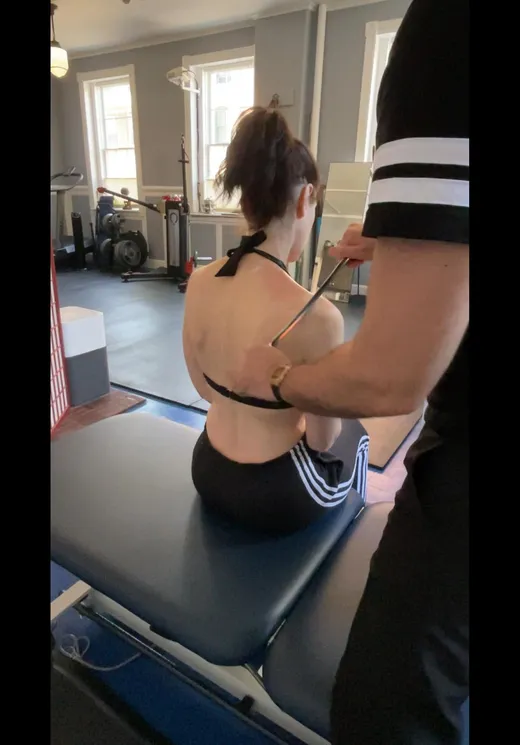
IASTM is a manual therapy technique that uses specially contoured stainless steel instruments to detect and treat dysfunction in soft tissue: fascia, tendons, ligaments, and muscle. The instrument is pressed and moved across the skin at specific angles and pressures. When it crosses tissue that has lost its normal texture, thickened fascia, scar tissue, adhesions, or a dense trigger point, the clinician feels a change in resistance. That texture change is information. It tells you exactly where to work.
At the tissue level, the controlled mechanical stimulus triggers a local inflammatory response. That sounds alarming, but it is the mechanism. The body reads the signal and sends fibroblasts to remodel the collagen in the area. Disorganized scar tissue and fascial adhesions are replaced, over time, with tissue that is more pliable and better aligned. This is not a theory. It is the same biological process that underlies most effective manual therapies, applied with greater specificity.
The short version: IASTM does not just loosen tissue temporarily the way a massage might. It creates the conditions for the tissue itself to change.
Why Tools Work Where Hands Alone Cannot Reach
A skilled clinician's hands can feel a great deal. But fascia and scar tissue can be dense, layered, and located in places where direct manual pressure is difficult to apply with precision: along a tendon sheath, across a bony ridge, through layers of adhered tissue following surgery. The instrument concentrates force into a smaller contact area and transmits subtle texture feedback back to the clinician's hand in a way that broad-palm palpation cannot replicate.
This is for you if
- You want hands-on bodywork: fascia, joint, nerve, needle. Not a program of exercises.
- You have already tried PT, massage or chiropractic and are still in pain.
- Your problem is chronic, recurring, or has never been explained to your satisfaction.
- You would rather have one hour with the doctor than three appointments with three people.
- You are willing to pay out of pocket for undivided expert attention.
This is not for you if
- You are looking for an exercise-based rehab program supervised by an aide.
- You need a clinic that bills your insurance directly and books you three times a week.
- You have an acute traumatic injury that needs imaging or surgical evaluation first.
- You want a single visit that makes a decade-old pattern disappear.
Conditions IASTM Treats at Physica Medica
IASTM is most effective when the underlying problem involves restricted or disorganized soft tissue: fascia that has thickened after injury, scar tissue from surgery or trauma, tendons that have lost their normal glide, or chronic trigger points that have not responded to other treatment. It is also useful as a diagnostic tool. Running the instrument across a region often reveals restrictions the patient was not even aware of.
A shoulder that lives in the rib cage
Conditions commonly treated with IASTM at Physica Medica include chronic neck pain and headaches driven by fascial restriction, back pain with a history of poor response to standard PT, plantar fasciitis and Achilles tendinopathy, IT band syndrome, rotator cuff tendinopathy, post-surgical scar tissue restriction, and movement dysfunction following old injuries that were never fully resolved. TMJ and jaw tension respond well too, particularly in singers and performers where the surrounding fascial structures are involved.
A hip held by a fifteen-year-old scar
Deep hip pain, clean imaging, no explanation. An old abdominal incision had bound the fascia above it, and every stride was pulling against that anchor. Mobilize the scar and the stride returns.
IASTM vs. Graston Technique — Understanding the Difference
If you searched for Graston technique in Baltimore and found this page, here is the distinction worth knowing. Graston is a specific branded protocol — a particular set of instruments and a proprietary treatment system developed by one company. IASTM is the broader category. It describes any approach that uses instruments to mobilize soft tissue.
Is IASTM Painful? What to Expect
During treatment
IASTM creates a sensation that most patients describe as a firm, focused pressure, somewhere between deep massage and scraping. When the instrument crosses a genuine restriction or trigger point, you will feel it. That discomfort is diagnostic as much as it is therapeutic. It is not the goal, but it is a signal that the instrument has found something worth treating. Dr. Birikov works within your tolerance and adjusts depth and pressure accordingly.
After treatment
Some redness is normal and expected. This is the local circulatory response that initiates tissue remodeling. Mild bruising can occur, particularly over areas with significant fascial restriction or scar tissue. This is not damage; it is a byproduct of the controlled inflammatory stimulus. Most patients experience one to two days of soreness in the treated area, similar to the feeling after deep tissue work. Plan accordingly if you have a physically demanding day immediately after your session.
Treatment, same visit
The marks fade. The tissue change is the point.
An honest arc
Before you leave, an estimate of how many sessions this will take and what will change first. Most patients feel meaningful change within four to six.
Deep manual work can be intense while it is happening and can leave a day or two of soreness, the kind that follows hard exercise rather than injury. Cupping can leave circular marks that fade within a week. Dr. Birikov talks through pressure as he works and adjusts on request. Nobody is asked to endure anything silently.
Book an IASTM Session in Baltimore
How is one-on-one physical therapy different from PT at a regular clinic?
Physica Medica is located at 800 S Bond St, Baltimore, MD 21231. Dr. Birikov sees patients one at a time, for the full session. No aides, no shared appointments. If you have been told your imaging is clean, if the pain keeps coming back, or if you have never been given a satisfying explanation for what is actually wrong, that is the conversation worth having.
How many sessions will I need?
Sessions are out-of-network. HSA and FSA are accepted. Dr. Birikov reads every inquiry personally and responds directly. Reach out by phone at 443-228-8029 or send a message describing what hurts, what you have already tried, and what has not been explained to your satisfaction.
Do you take insurance for one-on-one physical therapy?
No. Physica Medica is out-of-network by design. Reimbursement rules dictate session length and staffing, which is precisely what makes this format impossible inside them. Sessions are paid out of pocket; HSA and FSA funds are accepted and a superbill is provided for out-of-network claims. Rates are quoted plainly before you book.
Frequently Asked Questions
What does IASTM (scraping therapy) actually do to soft tissue? The instrument creates a controlled mechanical stimulus at the skin and fascial surface. This triggers a localized inflammatory response that signals the body to remodel the tissue in the area. Disorganized collagen from old injuries, thickened fascia, and scar tissue are gradually replaced with more pliable, functional tissue. The redness and mild soreness after treatment are part of this process, not side effects to be avoided.
Is IASTM the same as Graston technique? Graston is one branded system within the broader category of IASTM. It uses proprietary instruments and a specific protocol. Dr. Birikov uses instrument assisted soft tissue mobilization as a clinical skill applied with independent judgment. Instrument selection, pressure, and treatment area are determined by what the tissue requires, not by a fixed protocol. For most patients the practical difference is that the treatment adapts to what is found, rather than following a standardized sequence.