Scoliosis Treatment in Baltimore | Physica Medica | Physica Medica
Skip to content
Physica Medica logo
Physica Medica logo Consult
Physica Medica logo
Request a Consultation
Back Pain · Baltimore

Scoliosis Doesn't Have to Be a Waiting Game

Most scoliosis patients are handed two options: monitor the curve or consider surgery. There is almost nothing offered in between. Dr. Birikov works in that gap — with active, hands-on correction work that most clinics in Baltimore simply don't do.

Dr. Maks Birikov, DPT — the first and only Functional Patterns practitioner in Baltimore, and the first master-level dry needling practitioner in the city.

Request a Consultation

Full-hour, one-on-one sessions in Fells Point. No referral required.

Why It Returns

Understanding Scoliosis — What's Happening in Your Spine

Scoliosis is a lateral curvature of the spine — but that description undersells what is actually happening in the body. The curve is visible on imaging, but the problem extends far beyond the vertebrae themselves. Tight fascia, asymmetrical muscle loading, and compensatory postural patterns develop throughout the entire trunk, hips, and shoulders over time.

The spine doesn't curve in isolation. It curves because the surrounding soft tissue system has adapted around it. Muscles on one side shorten and tighten. The opposite side lengthens and weakens. The rib cage rotates. The pelvis tilts. What starts as a spinal structural issue becomes a whole-body postural compensation pattern — and that is the part most imaging reports don't capture.

This is why treating only the spine rarely produces lasting change. The curve is the result of a system that has reorganized itself. Correcting it requires working on the whole system.

The Approach

Why Most Scoliosis Patients Are Told to 'Just Watch and Wait'

If your curve is under 25 degrees, most orthopedic providers will tell you to come back in six months for another X-ray. If it's between 25 and 45 degrees, bracing is often recommended. Above 45 degrees, surgery enters the conversation. Active correction work — hands-on treatment aimed at reducing the curve and improving postural function — rarely gets mentioned at all.

That gap exists for a few reasons. Standard physical therapy for scoliosis tends to focus on general core strengthening, which can build muscle around a restricted system without addressing the fascial tightness and asymmetrical loading that drive the curve. Bracing slows progression in adolescents but doesn't correct what's already there. And surgery addresses the structural problem but leaves the soft tissue compensation patterns intact.

The result is that a large group of patients — adults with established curves, adolescents whose curves have stabilized, people who braced but never corrected — are left without a clear path forward. They're not sick enough for surgery. They're not improving with monitoring. And they've often been told there's nothing else to try. That's not accurate.

The Toolkit

Dr. Birikov's Approach to Scoliosis Correction

The assessment starts with the whole postural system, not just the curve. Dr. Birikov evaluates how the spine, rib cage, pelvis, and hips are loading relative to each other — identifying where fascial restrictions are pulling the spine off its axis and where muscular imbalances are reinforcing the pattern.

One-on-One Manual Therapy

From there, the work is manual and specific. Restricted tissue is released directly. The rib cage and thoracic spine are mobilized to restore rotation that the curve has locked out. Then posture re-education begins — retraining the body to hold a more symmetrical position once the tissue will actually allow it. This is not a stretching program. It is active correction work guided by what the tissue is doing in each session.

Learn more →

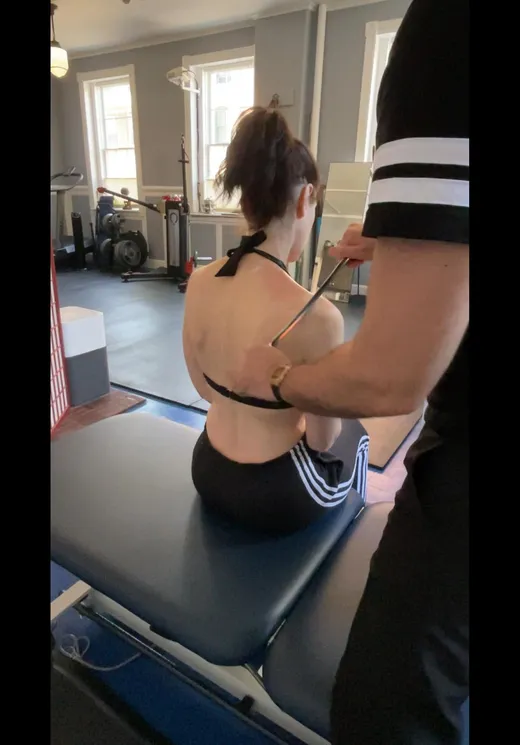
IASTM

Dr. Birikov also integrates Pancafit stretching and Functional Patterns methodology into scoliosis work. Pancafit uses a specialized inclined plane to decompress and elongate the spine under gravity, addressing the compressive forces that reinforce curvature. Functional Patterns addresses the movement habits and postural compensations that developed around the curve — so that as the spine corrects, the body learns to move in a way that supports the correction rather than pulling it back.

Learn more →

Dry Needling

A fine filament needle reaches a trigger point in deep spinal musculature and lets it release. Dr. Birikov is Baltimore’s first master dry needler, and the technique is within the licensed scope of physical therapy practice in Maryland.

Learn more →

Myofascial Cupping

Negative pressure lifts the fascia away from the layers beneath it, restoring glide and blood flow. The circular marks are normal and fade within a week.

Learn more →

Neural Tension Release

For back pain with radiating symptoms, the nerve is freed where it is actually bound, not where the numbness is felt.

Learn more →

Posture Re-Education

Once the restriction is gone, the loading pattern is retrained so the correction survives your working week.

Learn more →
Documented

Treatments Used for Scoliosis at Physica Medica

Each session draws from several tools depending on what the tissue requires that day. Most sessions combine two or three of the following.

One-on-One Manual Therapy

Before
After

Direct hands-on work to release fascial restrictions along the spine and trunk. This addresses the soft tissue tension that is actively pulling the curve tighter — not just the vertebrae themselves.

Honest Qualification

Who Is a Candidate for Scoliosis Treatment Here?

This is for you if

  • You have a diagnosed scoliosis curve and have been told to monitor it without any active treatment plan.
  • You completed bracing and want to address the residual curve and postural compensation patterns that remain.
  • You've tried standard physical therapy or chiropractic care and your curve or symptoms haven't improved.
  • You want hands-on correction work, not a home exercise program.

This is not for you if

  • You are prepared to pay out of pocket for full-hour, one-on-one sessions with the doctor.
  • Your curve is progressing rapidly and requires immediate orthopedic or surgical evaluation.
  • You have red-flag neurological symptoms such as progressive weakness, numbness, or changes in bowel or bladder function.
  • You are looking for insurance-billed visits and a supervised exercise circuit.
The Hour Itself

Take Action on Your Scoliosis in Baltimore

Most scoliosis patients who come here have already spent months or years in the 'watch and wait' category. They're not in crisis. They're frustrated — because they can see the curve, feel the asymmetry, and nobody has offered them a way to actually work on it. That is exactly the patient this practice is built for.

The first session is a full hour. Dr. Birikov assesses your posture, reviews your imaging if you have it, identifies the restriction pattern driving your curve, and begins treatment in the same visit. You leave with a clear picture of what is contributing to your scoliosis and what the correction work will target.

Most patients with scoliosis require a longer course of treatment than a standard musculoskeletal complaint — typically 8 to 12 sessions for meaningful postural change, depending on curve severity, tissue quality, and how long the pattern has been established. Dr. Birikov will give you an honest assessment after the first session.

Good Questions

Frequently Asked Questions

How is hands-on physical therapy different from exercise-based PT for back pain?

Can scoliosis be corrected without surgery in adults? In many cases, yes — meaningful improvement is possible. Surgical correction is generally reserved for severe curves or cases with significant neurological involvement. For adults with mild to moderate curves, active manual therapy, postural correction, and fascial release can reduce the functional impact of the curve and, in some cases, reduce its degree over time. The realistic goal depends on your curve, your age, and how long the compensation patterns have been in place. Dr. Birikov will tell you directly what he thinks is achievable after assessing you.

How many sessions will I need for back pain treatment?

What makes Dr. Birikov's scoliosis treatment different from standard physical therapy? Standard PT for scoliosis typically focuses on strengthening exercises and general postural awareness. That approach loads a system that is still restricted — which is why many patients see limited progress. Dr. Birikov's work begins with releasing the fascial and muscular restrictions that are maintaining the curve before any postural retraining begins. He also integrates Pancafit decompression and Functional Patterns, tools that are not available at conventional PT clinics in Baltimore.

Can you treat back pain that hasn’t responded to other therapies?

How many sessions does scoliosis correction typically require? Scoliosis is not a short-course condition. Most patients see initial postural changes within 4 to 6 sessions, but meaningful, lasting correction generally requires 8 to 12 sessions or more depending on curve severity and tissue response. This is longer than a typical back pain case because the compensation patterns are deeply established and involve the whole postural system. Dr. Birikov will give you a realistic estimate after your first session.

The Next Step

Take Action on Your Scoliosis in Baltimore

Send a message describing your curve, how long you've had it, and what treatment you've already tried. Dr. Birikov reads every inquiry personally and responds directly — not through a front desk or patient coordinator.

Physica Medica is located at 800 S Bond St, Baltimore, MD 21231, in Fells Point. You can also reach the office at 443-228-8029. No referral is required to book.

Preview Give Feedback