
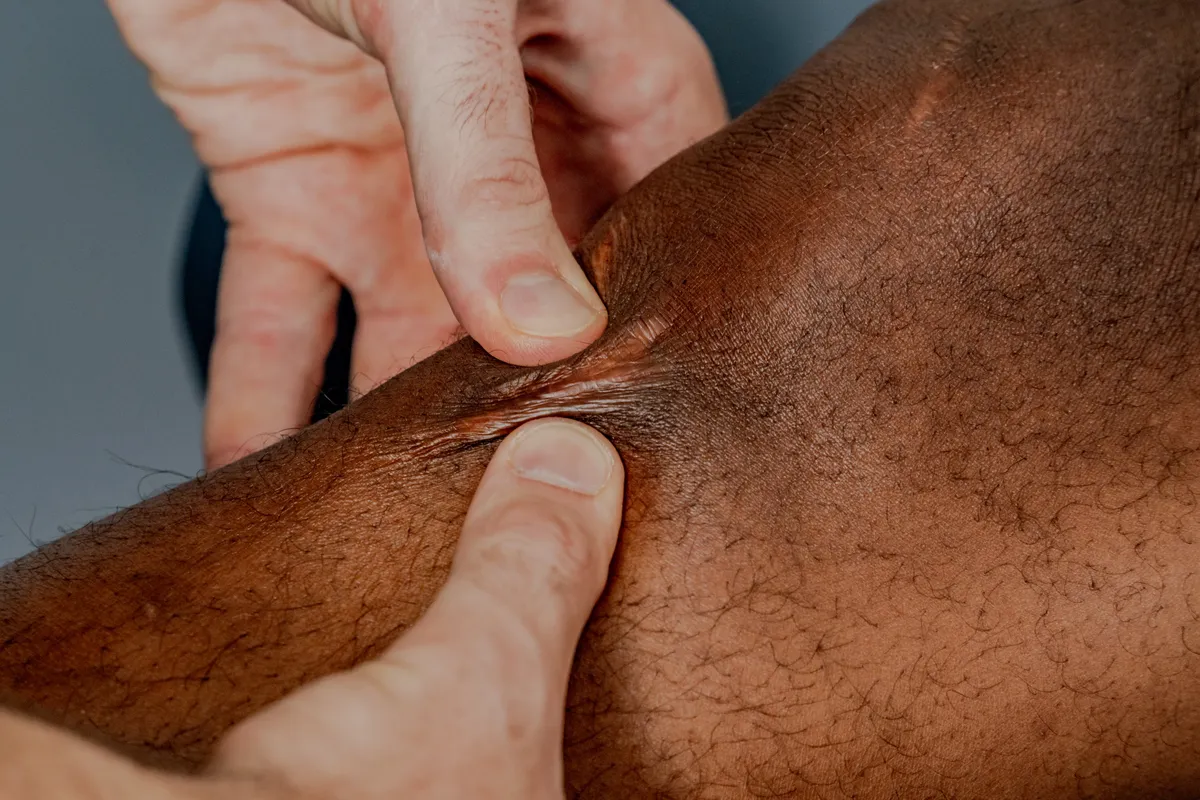
Scar Tissue Mobilization in Baltimore
Dr. Maks Birikov, DPT · Manual therapy for internal and surface scar tissue · Post-surgical rehab and chronic restriction
A full hour of hands-on work, every session. Scar tissue that has never been directly treated is often the reason nothing else has held.
Out-of-network by design. HSA and FSA accepted.
Why Scar Tissue Becomes a Problem, and Why It Is Rarely Treated
When tissue heals after surgery or injury, the body lays down collagen in a dense, disorganized pattern. That is scar tissue. On the surface, it may look like a faded line. Underneath, it can bind to muscle, fascia, and nerve tissue in ways that restrict movement and generate pain for years.
Most post-surgical rehab focuses on strength and range of motion. The scar itself, and the internal adhesions it creates, is rarely addressed directly. So patients finish rehab, pass their discharge criteria, and still feel pulling, tightness, or a vague ache they cannot explain. The scar is the explanation.
This is not a surface-level cosmetic concern. Internal scar tissue from a C-section can restrict hip movement. An old appendectomy scar can tether the fascia along the entire right side of the abdomen. A shoulder surgery scar can limit rib cage mobility in ways that show up as chronic neck tension. The body does not treat scars as isolated events, and neither does Dr. Birikov.
How Dr. Birikov Mobilizes and Remodels Scar Tissue
Scar tissue does not respond to general massage. It requires specific, sustained manual pressure applied directly to the adhesion, with enough force and duration to begin remodeling the collagen fibers. This is skilled work, and it requires knowing where the restriction is, not just where the pain is.
The tools Dr. Birikov uses for scar tissue work
- Direct manual mobilization: sustained pressure and cross-friction applied by hand to break up adhesions and restore tissue glide between layers
- IASTM (instrument-assisted soft tissue mobilization): a stainless steel instrument used to detect and treat dense scar tissue with controlled shear force, reaching adhesions that hands alone cannot isolate
- Myofascial cupping: negative pressure applied over and around scar tissue to lift and decompress the fascial layers, improving circulation and tissue mobility in the surrounding area
- Dry needling: fine needles placed into trigger points and restricted tissue near the scar to release muscle guarding and restore normal tissue tone in the affected region
- You are willing to pay out of pocket for undivided expert attention.
This is not for you if
- You are looking for an exercise-based rehab program supervised by an aide.
- You need a clinic that bills your insurance directly and books you three times a week.
- You have an acute traumatic injury that needs imaging or surgical evaluation first.
- You want a single visit that makes a decade-old pattern disappear.
Conditions and Surgeries That Benefit from Scar Tissue Work
Scar tissue mobilization is appropriate for a wide range of post-surgical and post-injury presentations. Both recent scars and old ones can be treated. The approach differs, but neither is too late.
Surgeries and injuries that commonly produce restrictive scar tissue
Chronic pain with clean imaging is one of the clearest signals that scar tissue or fascial adhesion may be involved. If your MRI shows nothing and you are still in pain after surgery, the scar is worth examining directly.
A hip held by a fifteen-year-old scar
Deep hip pain, clean imaging, no explanation. An old abdominal incision had bound the fascia above it, and every stride was pulling against that anchor. Mobilize the scar and the stride returns.
What to Expect During and After Treatment
Scar tissue mobilization is not comfortable. That is worth stating plainly. Dense adhesions resist pressure, and effective treatment requires working through that resistance. Most patients describe it as an intense, deep pressure, uncomfortable in the moment, but distinct from sharp or alarming pain.
Book a Scar Tissue Mobilization Session in Baltimore
History, briefly
No referral is required. If you have had surgery, recently or years ago, and you are still dealing with restriction, pulling, or unexplained pain in the area, scar tissue mobilization may be the piece of treatment you have not yet tried.
Assessment by hand
Physica Medica is located at 800 S Bond St, Baltimore, MD 21231. Reach Dr. Birikov directly at 443-228-8029. Send a message describing what hurts, what surgery or injury caused it, and what you have already tried. Dr. Birikov reads every inquiry personally and responds directly.
Treatment, same visit
You are treated on day one. Manual release, needling, cupping or instrument work: whatever the findings call for.
An honest arc
Before you leave, an estimate of how many sessions this will take and what will change first. Most patients feel meaningful change within four to six.
Deep manual work can be intense while it is happening and can leave a day or two of soreness, the kind that follows hard exercise rather than injury. Cupping can leave circular marks that fade within a week. Dr. Birikov talks through pressure as he works and adjusts on request. Nobody is asked to endure anything silently.
Frequently Asked Questions
How is one-on-one physical therapy different from PT at a regular clinic?
How long after surgery can scar tissue mobilization begin? For surface incisions, direct mobilization typically begins once the wound has fully closed, usually six to eight weeks post-surgery, with your surgeon's clearance. Internal fascial work may begin sooner in some cases. If you are recently post-operative, bring your surgical notes and discharge instructions to the first session.
How many sessions will I need?
Can old scars still be treated, or only recent ones? Old scars can absolutely be treated. Scar tissue does not stop responding to manual therapy just because time has passed. Many patients come in with restrictions from surgeries performed five, ten, or fifteen years ago and see meaningful improvement. The tissue may be denser and require more sessions, but it is not a closed window.
Do you take insurance for one-on-one physical therapy?
Does scar tissue mobilization hurt? It is typically uncomfortable, especially in the first one or two sessions when the adhesions are densest. Most patients describe it as a deep, intense pressure rather than sharp pain. The soreness that follows usually resolves within 48 hours. Dr. Birikov works within your tolerance and adjusts pressure based on what the tissue is showing, not a fixed-force approach.
Ready to Address What Surgery Left Behind
If you have been told your imaging looks fine but you are still restricted, still in pain, or still not moving the way you did before surgery, the scar tissue is worth examining. Send what hurts, what procedure caused it, and what you have already tried.
Dr. Birikov reads every inquiry personally and responds directly. No front desk, no intake form routed to a scheduler.